Riley's Note
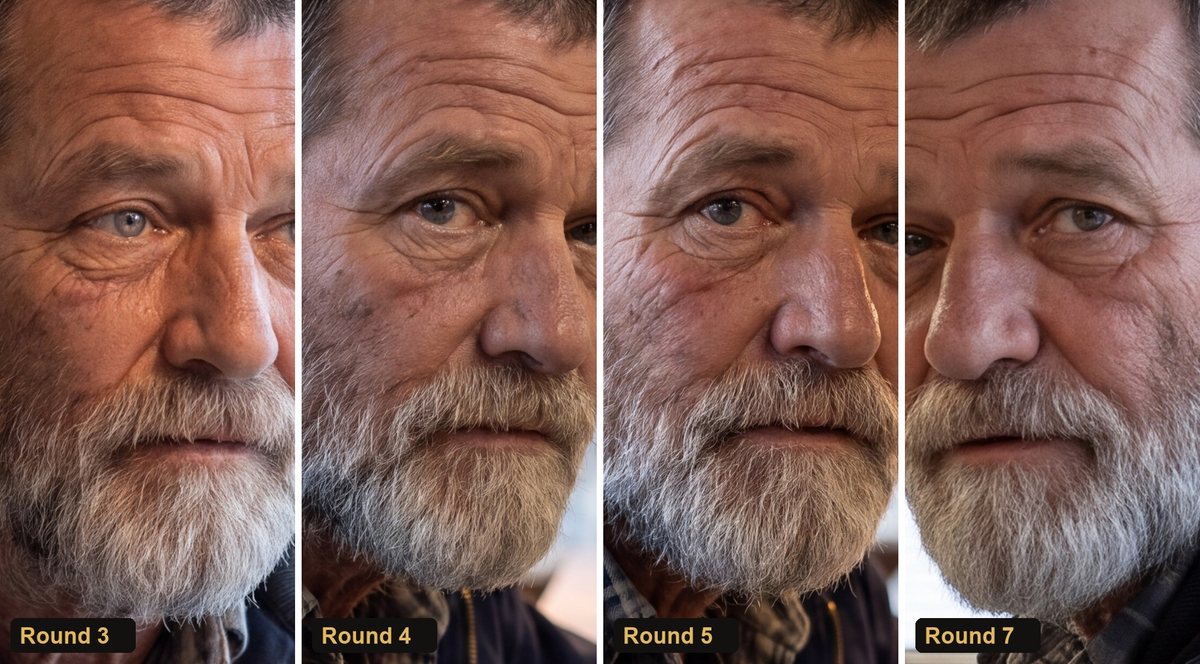
Hey {FIRSTNAME}, the four faces above are the same man, and he doesn't exist. We spent 25 generations on making him pass for a real photograph, counting two test faces, two empty rooms and three video tests. We kept none.
Skin is where AI portraits die, and nothing we typed saved this one. The room we did fix, and that part you can steal today. About a 6-minute read.
The Breakdown | Every issue
The job: one diner-counter portrait a working photographer would believe. Every image here is AI-generated, by us, on KIE.

Round 1. "Cinematic film still" on Nano Banana 2.1. Every surface came back with the same gloss.
Round 2. We listed pores, wrinkles and sensor noise on Nano Banana Pro and asked for a wide-open f/2 lens. We got every pore, and almost 8% of the frame crushed to black.
Round 3 was a camera brief: lens, aperture, a window as the main light, a readable room. We ran it image-to-image, so the model started from a picture. Ours was the round-2 image, jacket patch edited out, to keep him the same man. It passed our own focus and face-match checks.
So we tried to fool someone. Close crops of our faces went into a folder with four real Unsplash portraits, shuffled. Two AI reviewers, separate Claude agents given only the folder and a short brief, called each face real or fake. We ran that four times with fresh reviewers, 40 verdicts on the real photos in all.
Round 3 got four verdicts. Every one said fake: waxy sheen, glassy blue eyes, a painterly beard.
Round 4 asked for a tighter frame. The model gave us his face at 17% of the frame width, where we'd asked for about a third. It had its own idea of a close-up. One pair of reviewers called it real; the next pair called it fake.
Round 5 ran 2K against 4K. The 4K came out cleaner, and the only pair that saw it called it real. It still ignored the framing.
Then our founder put the rounds side by side and stopped us. A pendant lamp hung at head height, right behind him in one shot. The window changed walls between rounds. Not one room had a ceiling.
Real diners have ceilings | Lock the set
We pulled five real diner photos, each with its camera listed. The gaps were boring and obvious:
- Ceilings. Drop tiles and flat fluorescent panels. Most of the light comes from up there and the windows.
- Pendants, when there are any, hang high and small. Two of the five had none.
- Stuff. Ketchup, napkin dispensers, menus, a soda fridge, staff at work, worn furniture.
- Wider lenses. Most were shot wider than our 85 mm, so the room stays readable behind people.
Round 6 wrote that room like a location scout, generated it empty, then handed it to the model as an image:
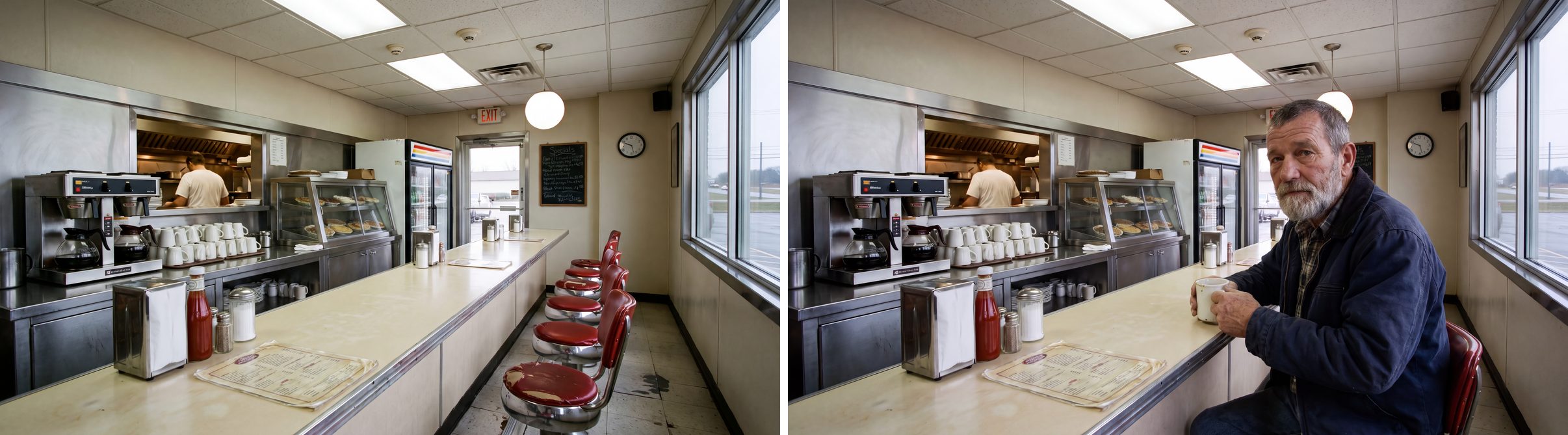
The model kept the empty room's camera angle and pasted him on top. That's a reshoot.
Round 7 described the room in text and generated him inside it, in one pass. He's finally sitting in it:
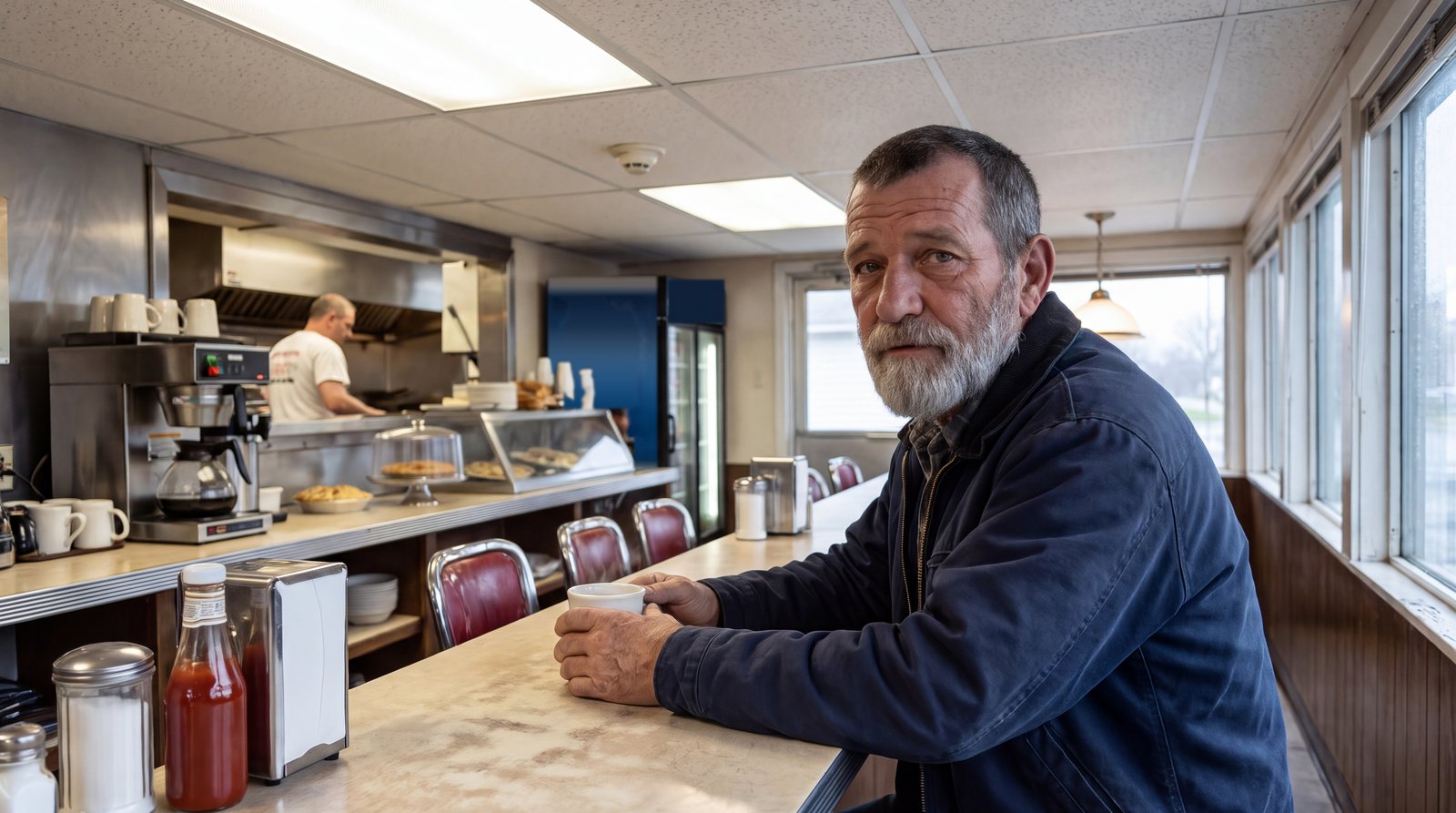
The full prompt, word for word. Settings: Nano Banana Pro on KIE, image-to-image with the same reference, 4K, 16:9, PNG, 24 credits (about 12 cents) a run. The ceiling and the high pendant do the most work. Note the last line. The model ignored it.
Image 1 shows the man to photograph. Keep his exact identity: same face and skull shape, age about 58, grey-brown eyes, nose, ears, hairline, short grey beard, the same navy canvas work jacket over a flannel shirt. Do not beautify, de-age or smooth him. He is a customer in a small, real, working American roadside diner on a grey weekday morning: a long cream laminate counter with a stainless edge, fixed chrome stools with worn red vinyl seats, a back bar with a commercial coffee brewer, glass carafes, stacked white mugs, a pie case and a soda cooler, a kitchen pass-through where a cook in a white T-shirt works, a napkin dispenser and a ketchup bottle near him, a white drop ceiling with flat fluorescent panels and a smoke detector, and a long window on the right-hand wall with flat overcast daylight. One small white globe pendant hangs high on a short stem just under the ceiling, further down the room; it is small in the frame, well above and to the side of his head, never behind or near his head. He sits on one of the red stools with his forearms on the counter and both hands around a white ceramic mug, body toward the counter, head turned a little toward the camera, looking just past the lens. He is really in the room: the stool under him, his elbows on the counter, the same light on him as on everything around him. Light is the room's own: even, slightly cool fluorescent light from the ceiling plus grey daylight from the window, a little brighter on the side of his face nearest the window. Camera: a customer standing in the aisle about 1.5 metres from him, at his seated eye height, full-frame 50 mm lens at f/4, framed from his waist up so his head and shoulders fill a large part of the frame; the back bar and the window are readable behind and beside him. Ordinary documentary photograph. Natural exposure and colour, as captured, unretouched. No readable text, no logos.
His face still failed. Both reviewers called it fake and named the same thing: an even, crunchy skin texture, equally sharp everywhere. Every face Nano Banana Pro made for us carried it.
Cost: 547 credits, about $2.74, for 25 generations (22 stills, 3 video tests). About 11 cents an attempt. Zero keepers, so there's no cost per usable shot to quote.
Next test: the same prompt on Seedream 5 Pro, which cost us 14 credits a run in an earlier comparison.
Hold it next to a real photo | Steal this
We'd built a focus check: are the eyelashes crisper than the cheek? One real photo failed it. It measures focus. It can't spot a fake.
Our AI reviewers called the real photos real 25 times out of 40. By the rule in the kit below, that panel isn't good enough to pass anything. It's only good at catching gross failures, and it caught plenty: faces equally sharp from forehead to beard, beards combed instead of tangled, and a "small scar" we asked for on another face that came back as a fresh red cut. The final gate is a human looking at full size.
Our blind-test kit:
1. Crop every face to the same size (640-900 px) and re-save it, which drops the metadata.
2. Put 4 real photos in with yours. One image per person, so nobody compares two takes of the same face.
3. Shuffle and rename to face_1, face_2 ...
4. Two judges, working separately, call each one REAL or AI, with a confidence from 1 to 10.
5. Trust the result only if they call your real photos real at least 3 times in 4. Ours managed 25 in 40.
Do it yourself | About 48 cents
- Save three real photos close to your shot from a free stock site. Keep them open while you judge, and don't feed them to the model.
- Write the room from those photos: ceiling, lights, clutter, people working.
- Generate one wide master at 4K with your subject inside the room. Our crunchiest skin came from the 2K run. Crop the close-up, keeping the face at least 640 px wide, the smallest size we judged at.
- Run the blind-test kit on your crops, with people as judges if you can get them.
Four Nano Banana Pro runs at 4K cost 96 KIE credits, about 48 cents. We've only run this on KIE, so treat other models as untested.
Light it like a DP | Camera Language
No Film School wrote up a three-step lighting system from cinematographer Edward Crockett on November 5. Two of its rules matter here. Motivate your light, so it comes from something in the scene, like a window or a lamp. And put the camera on the shadow side, at least 90 degrees from the key (your main light), with the subject between the lens and the light.
Typing "shadow side" did nothing for us. Spelling out where the window and the camera sit worked once in five runs.
Quick Hits
- Gemini Omni 1.2 Flash refines its own clips through multi-turn prompts: our breakdown and a 40-cent test plan. Google also says Vids makes 15-second clips with it at no additional cost. Why it matters: if a follow-up prompt can fix one beat, you stop paying to re-roll a whole clip. Vendor-stated; we haven't run it yet.
- Higgsfield's guide to why AI video generations fail counts eye colour shifts among the signs of identity drift. In round 4 we wrote grey-brown. He came back blue. Why it matters: if the eyes drift in a still, they'll drift in motion.
- HeyGen's API changelog now lists Cinematic Avatar shots on HeyGen Video: 16:9 or 9:16, 720p, five to fifteen seconds, with as many as three audio references. Why it matters: your avatar can be cast inside a generated shot instead of a talking-head frame. HeyGen's claim; untested by us.
Your Turn
Fifteen minutes on free credits: make one portrait, put it next to three real photos at 100%, and ask a friend to pick the fake. You pass if they can't pick yours inside 60 seconds.
Reply with how long it took them and your model. We'll share the best, with your permission.
From the Bootcamp
Our skin never passed, and the first job was finding where it broke. In the Bootcamp's AI Image Studio, Fix the Synthetic Look has you score three of your own frames on an eight-point diagnostic and name the first break in each. See what's inside.